Important Autumn Sale 2026
Se live-streaming here
Knud Bergslien (1827–1908) was one of Norway’s leading artists and art teachers of the 19th century. Today, he is particularly well known for his historical paintings, but he also played an important role in educating the next generation of Norwegian artists through Bergslien’s School of Painting in Kristiania. Bergslien is best known for his depictions of folk life and historical subjects, which were, among other things, inspired by his fellow artist Adolph Tidemand.
Knud Bergslien was born in Voss into a family with strong artistic traditions. He was the brother of sculptor Brynjulf Bergslien and the uncle of artist Nils Bergslien. He demonstrated artistic talent from an early age. While attending the Non-Commissioned Officers’ School in Bergen, he was granted exemption from part of his military service so that he could attend classes at the Bergen Drawing School. He later studied under the landscape painter Hans Leganger Reusch. In order to further develop his artistic skills, Bergslien travelled to Antwerp and Paris. After several years, he returned to Bergen, where he worked as a teacher and portrait painter. In 1853, he moved to Kristiania (now Oslo), where he established himself as an artist.
A government grant enabled Bergslien to travel to Düsseldorf in 1855. At the time, the city was an important centre of National Romantic art, and his stay there had a profound influence on his artistic development. It was here that he painted several works that would later become iconic images in Norwegian art history. Among his best-known paintings are The Birkebeiner Skiing Across the Mountains with the Royal Child and King Sverre in the Mountains of Voss. Through such subjects, Bergslien helped bring Norway’s medieval history and the national narrative, which played a central role in 19th-century visual culture, to life.
Towards the end of the 1860s, Bergslien returned to Kristiania, where he resumed his work as a painter. Portraiture became a particularly important part of his artistic practice. A decisive chapter in Bergslien’s life began in 1870, when the artist Johan Fredrik Eckersberg died and Bergslien took over the management of the Kristiania School of Painting together with the landscape painter Morten Müller. A few years later, he ran the school on his own and renamed it Bergslien’s School of Painting. It became one of Norway’s most important institutions for art education, where many artists who would later achieve national recognition received their initial training. Bergslien directed the school until around 1900, and through his teaching he left a lasting mark on Norwegian art.
Both as a painter and as a teacher, Knud Bergslien helped shape Norwegian art during a period characterised by nation-building, historical awareness and the development of a professional art community. His artistic work and teaching had an influence that extended far beyond his lifetime. One example of the recognition he received as an artist was the prestigious commission to paint the official depiction of the coronation of King Oscar II in Nidaros Cathedral in 1873.
Genre painting is a term used to describe paintings depicting everyday life, daily activities and people in ordinary situations. The subjects may include work, family life, celebrations, leisure activities or other scenes from daily life, often providing insight into the customs, environments and social conditions of a particular period or region. Unlike history painting and portraiture, which depict significant historical events and identifiable individuals, genre painting focuses on ordinary people and everyday situations. Throughout history, genre painting has served both as an artistic form of expression and as a record of people’s living conditions. As an artistic genre, it offers a unique insight into how people have lived, worked and organised their societies throughout different periods.
Genre painting has deep historical roots. Scenes from everyday life can already be found in ancient Egyptian tomb paintings, ancient Greek vase paintings and Roman wall paintings. During the Middle Ages, such motifs appeared sporadically in manuscript illustrations and religious art. During the Renaissance, interest in everyday subjects increased, particularly among Venetian artists such as Bellini, Carpaccio and Bassano.
Genre painting has throughout history served both as an artistic form of expression and as a record of people’s living conditions. The genre became particularly popular in the Low Countries during the 16th and 17th centuries. Artists such as Pieter Bruegel, Jan Vermeer, Pieter de Hooch and Gerard ter Borch developed genre painting into an independent art form. Their paintings depict everything from domestic interiors and family life to marketplaces, taverns and scenes of labour. Many of these works combine realistic observations with moral, religious or symbolic messages. In the 18th century, the tradition was continued by artists such as Jean-Baptiste Chardin in France and William Hogarth in England. Although the ideals of Classicism temporarily diminished the genre’s significance, it gained renewed relevance during the Romantic period, particularly through the Düsseldorf School’s depictions of everyday life and national traditions.
In the 19th century, genre painting became important within Naturalism. Artists such as Gustave Courbet and Adolph Menzel portrayed workers, farmers and urban life with greater emphasis on social realities and the conditions of everyday existence. The genre thus evolved from idealised representations towards more realistic observations of society. In Norwegian art, genre painting became particularly significant through artists such as Adolph Tidemand, Carl Sundt-Hansen, Christian Krohg and Gustav Wentzel. Their works documented everyday life, working conditions and social circumstances, and today constitute important visual sources for Norwegian cultural and social history.
When we encounter depictions of bear hunting in 19th-century paintings, the subject is often about much more than the hunt itself. These scenes express ideals of strength, courage and humanity’s relationship with nature. At the same time, they reflect a period when predators were a natural part of everyday life in rural communities. For artists such as Bergslien, such motifs offered a way to create images of Norwegian identity closely connected to nature, forests and outdoor life.
Bear hunting has a long history in Norway and has been associated with survival, livelihoods and culture. For centuries, people lived in close proximity to predators, and the brown bear was one of the most feared animals in Norwegian nature. Bears could prey on grazing livestock and, in some cases, pose a threat to human safety. Consequently, bear hunting was long encouraged by the authorities. During the 19th century, bounties were paid for the killing of predators, contributing to a dramatic decline in the bear population. Historically, bear hunting was extremely dangerous: firearms were less accurate than those used today, and a wounded bear could be deadly. Many accounts tell of hunters who were injured or killed during the hunt.
For artists such as Bergslien, these subjects offered a way to create images of Norwegian identity closely connected to nature, forests and outdoor life. By the beginning of the 20th century, bears had been driven close to extinction in large parts of Norway as a result of intensive hunting. Attitudes gradually changed, however, and the brown bear became a protected predator. Today, the population is managed through national population targets and strict regulations governing licensed hunting. The aim is to balance the protection of biodiversity with the interests of livestock farming. The brown bear is now considered an important part of Norway’s biodiversity, which the country has a responsibility to protect.
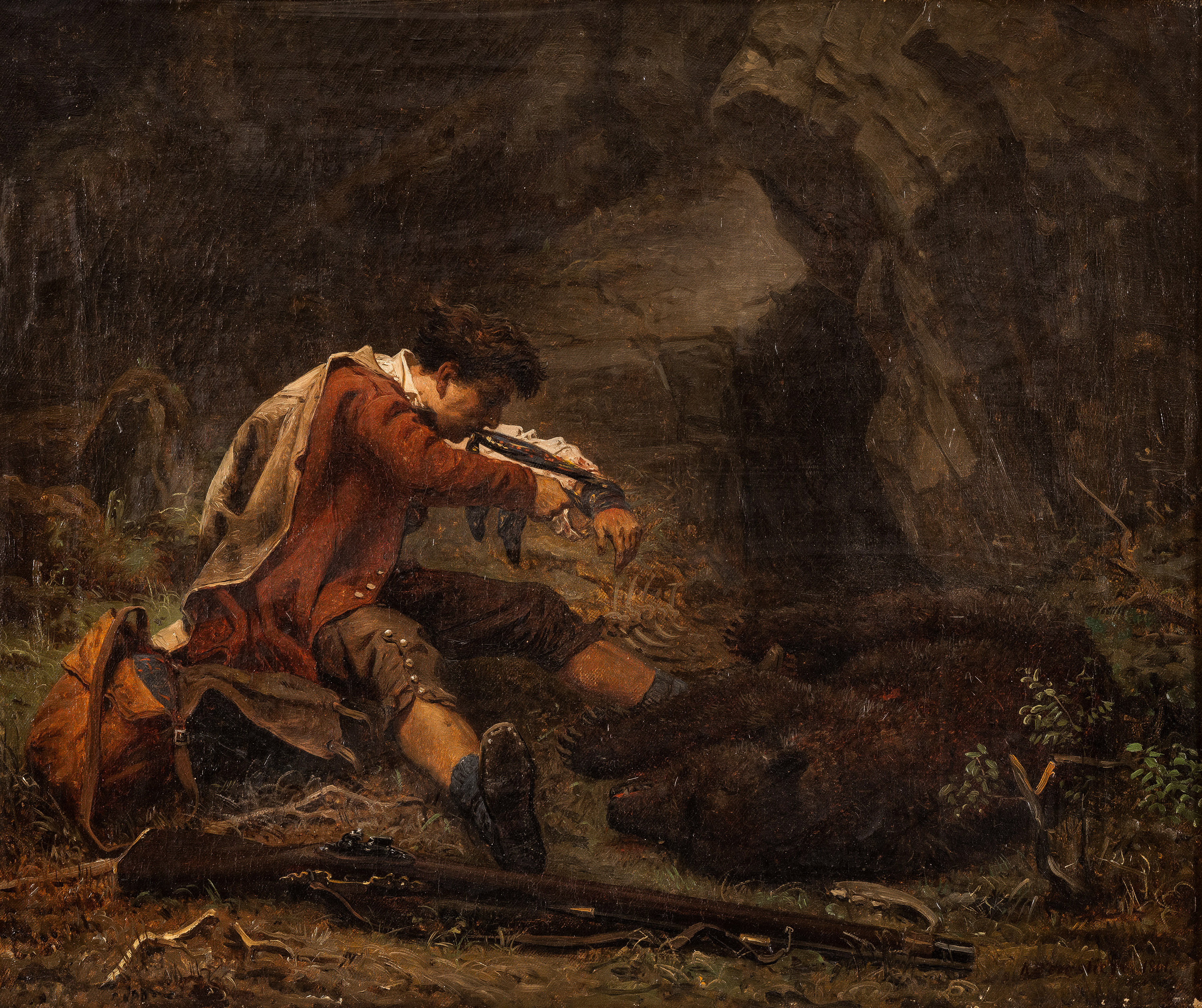
The bear has also held great symbolic significance. In folklore and traditional stories, it was often portrayed as the king of the forest, an animal that inspired both respect and admiration. Numerous legends, fairy tales and folk songs tell of encounters between humans and bears. Particularly in the forested regions of Østerdalen, Hedmark and Trøndelag, the bear hunter was a familiar figure. During the 19th century, bear hunting also became a popular subject in art. Artists depicted hunters and dramatic encounters between humans and the untamed wilderness. Such images fitted well with National Romanticism’s interest in Norwegian nature, history and everyday life. Several of Bergslien’s National Romantic motifs emphasised courage, endurance and humanity’s struggle against the forces of nature, particularly in relation to Norwegian rural life and the natural environment. One example is Wounded Bear Hunter (1861).
Text by Luisa Aubert
Se live-streaming here



Learn how to participate in auctions at Grev Wedels Plass Auksjoner (GWPA) – from registration to bidding and payment. This step-by-step guide ensures a smooth and secure experience throughout.
Be the first to receive news about auctions and sales, get notified when catalogues are available and get invitations to viewings and exhibitions.