Fresko at Nautical Academy at Kongshavn
Per Krohg writes art history as early as 1921, when he emerged victorious from the competition to decorate the newly built Nautical Academy at Ekeberg. From his studio in Paris, he regularly commutes to Oslo and transforms the school's entrance hall into a rich pictorial universe: on the ceiling, he lets the zodiac signs sail over visitors, while the walls depict the dramatic and lyrical moments of the sailor's life – all executed directly on wet plaster with classical fresco technique.
The project is met with skepticism along the way; Several critics fear that the fresh, almost naïve style clashes with the school's strict architecture. Krohg stands firm on his choice of clear lines and strong surfaces and completes the decoration in 1924. As the scaffolding is removed, public opinion turns: the press calls the frescoes a groundbreaking work, and the artist is immediately referred to as the country's leading monumental painter.
The new status opens doors, and Krohg brings in commissions in quick succession – including Hersleb School (1927), Oslo Lysverker (1930–32) and the University Library (1933) – and thus sets in motion a Norwegian "fresco wave". Eventually, he leaves Paris for good and moves back home to Oslo in 1932.
In retrospect, the Nautical Academy stands as the place where Krohg establishes a personal monumental language: he combines mythology and everyday realism, gives the fresco new life in Norway and proves that modern expressions can play on the side of classical craftsmanship. The decoration still serves as an active meeting between sea, sky and history – and as the starting point for a career that leads all the way to the UN Security Council chamber in the 1950s.
The women who stayed behind
The motif is a section of the large fresco Departure1924 (The Harbour),which is placed in the main vestibule. The mural depicts the joys and challenges of the sailor's life, with shipwreck and homecoming as motif-related narratives. Parts of the composition have a decorative touch, but in the motif of the harbor, Krohg seems to prefer a more natural and accurate idiom. This is especially true of his depictions of the people in the harbor, all of whom have an individuality and charm in their expression. Krohg emphasizes different types and character traits when he paints pier shacks, married couples strolling along the harbor, curious boys and remaining girlfriends.
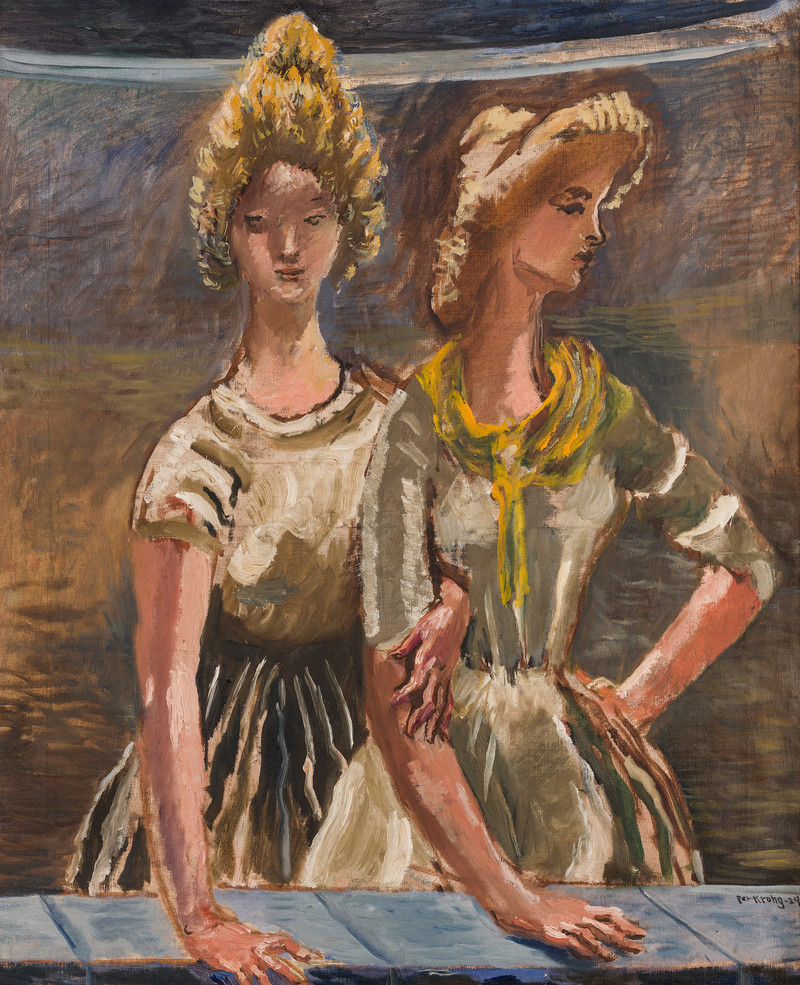
The painting Two Women, section for Departure II 1924 is a preparatory work for part of the fresco's foremost part. In the fresco, the double female portrait is placed by a large streetlamp. In the preparatory work, Krohg has let the woman make up the entire composition in a two-thirds figure, interrupted by the harbor wall in front. The women stand close to each other, and Krohg has painted them in an outfit that testifies that they belong to the working class. Perhaps they have said goodbye to their respective husbands together, and both face a long time alone with responsibility for home, finances and family. The woman's physical contact in the painting may tell us something about the support they depend on from each other in the coming days as "sailor's widows". until their husbands return.