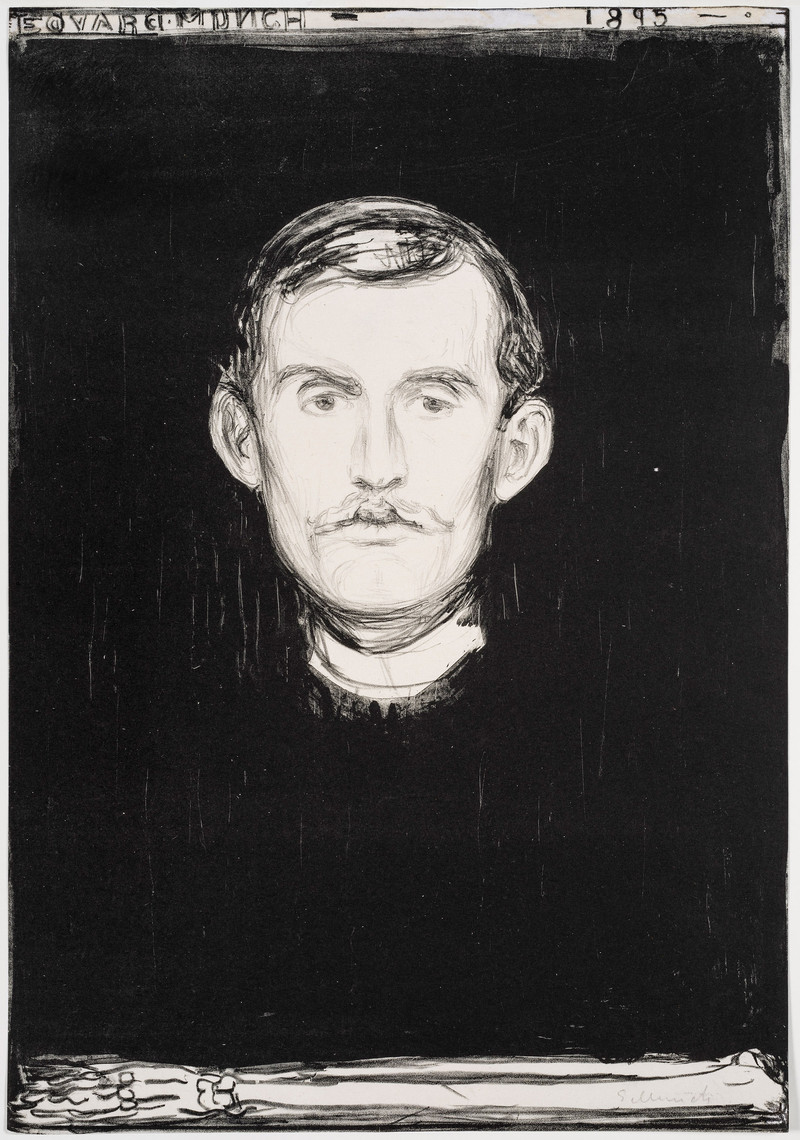
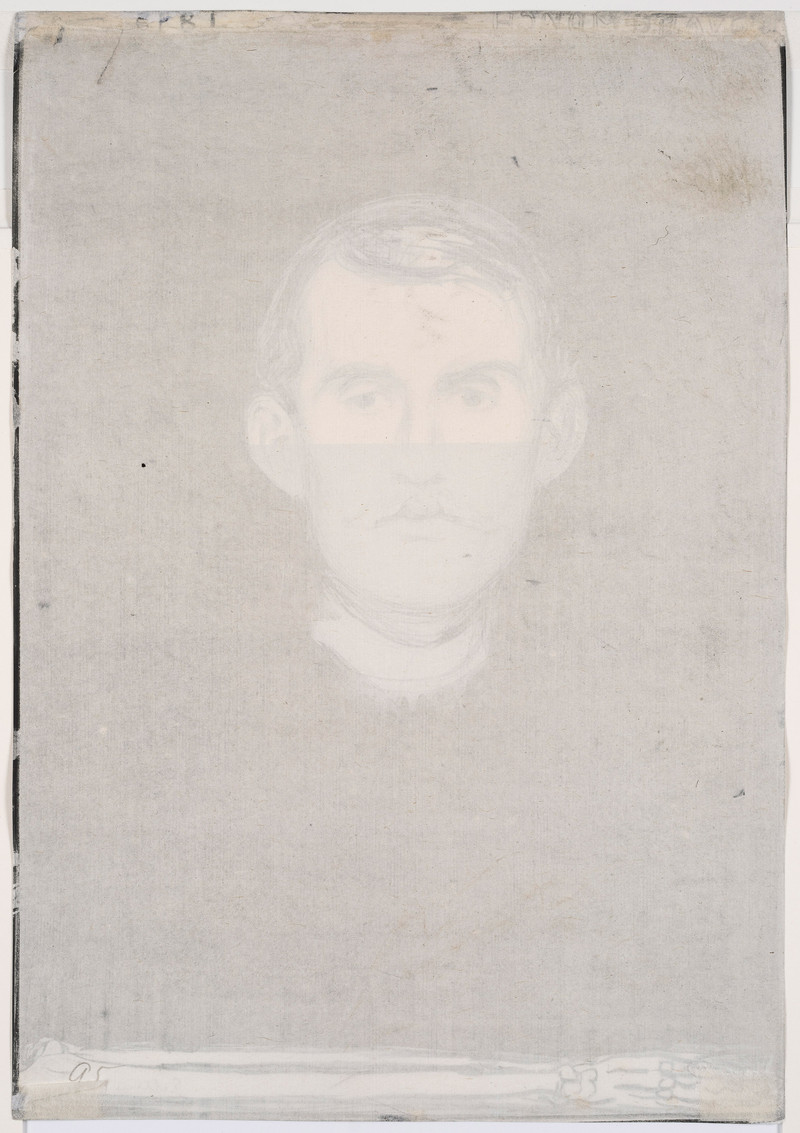
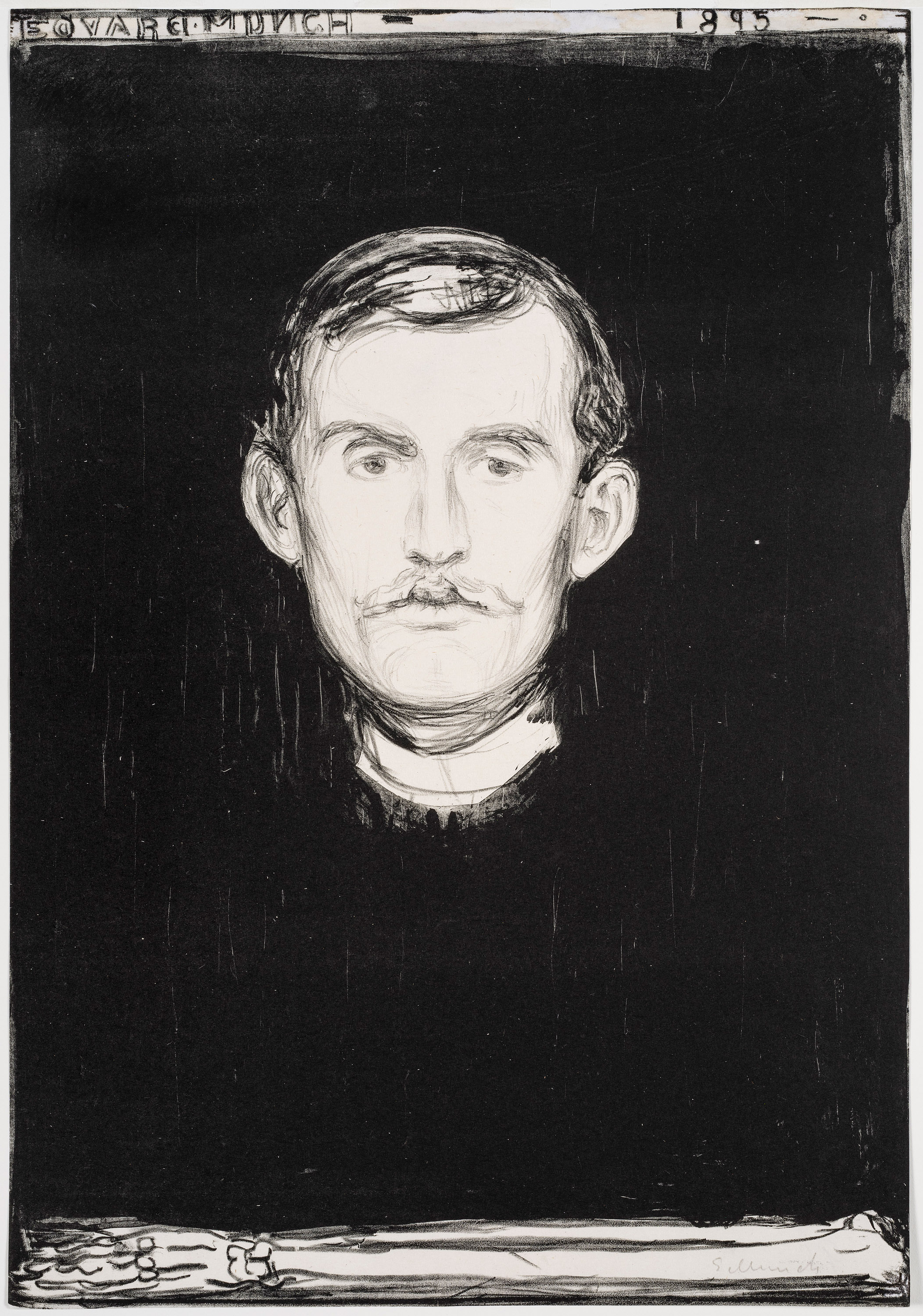
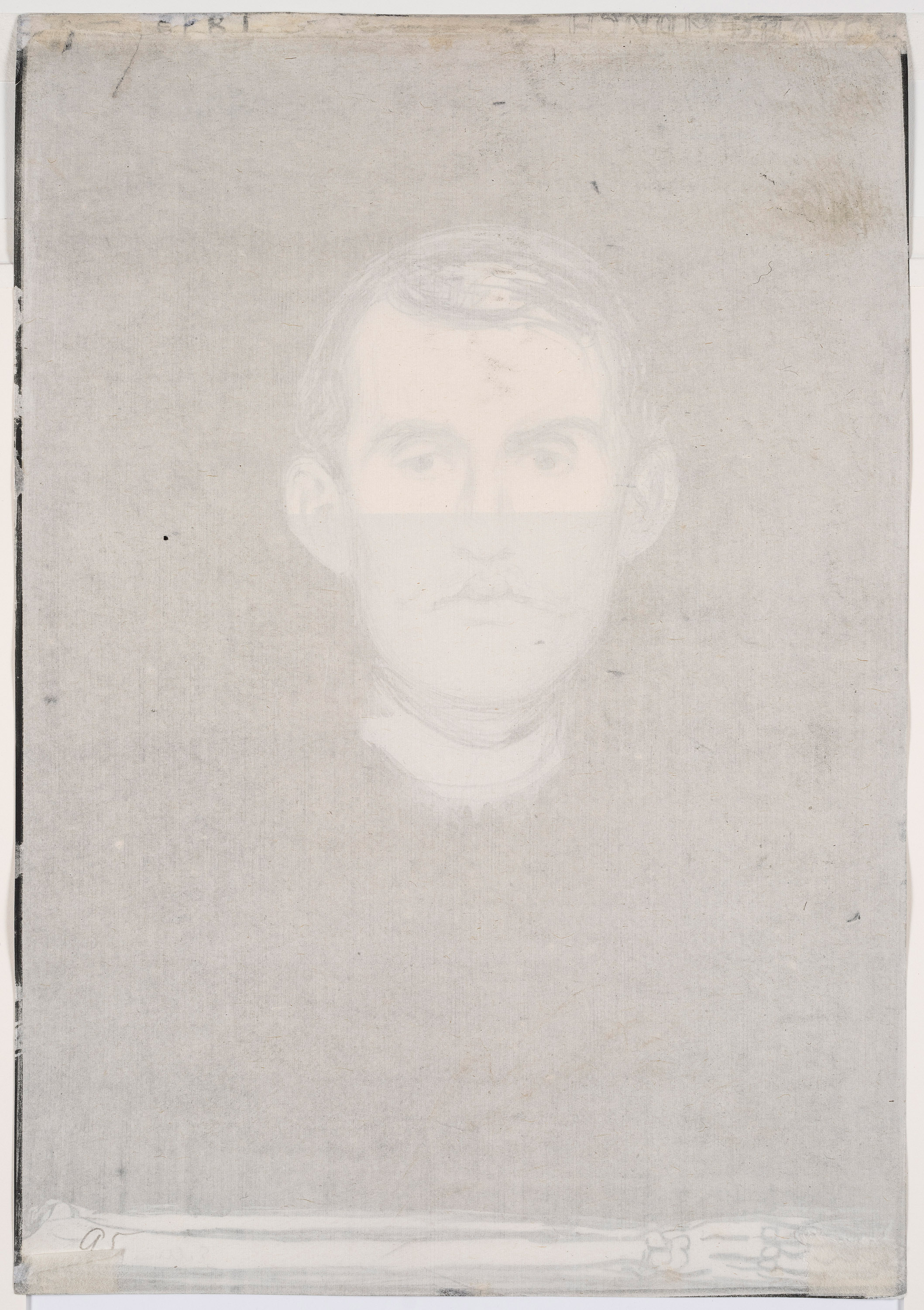
Self-Portrait (1895)
A distinct category of self-portraits in art history is that of vanitas allegories marked by symbols of death. The word vanitas comes from Latin and means emptiness; in a figurative sense, it serves as a reminder of the transience of life and the fleeting, superficial nature of worldly pleasures. To place life in its proper perspective, one should therefore continually remember death, as so-called memento mori. Historically, self-portraits featuring such symbolism have held strong appeal, and artists repeatedly return to the realization that the only certainty in life is death.
The lithograph Self-Portrait (1895) is a clear example of Munch’s use of death symbolism. Here, the artist’s serious face emerges against an undefined, dark background, while a reclining skeletal arm is placed at the bottom of the image. This arm functions almost like a frame within the composition. The arrangement recalls Renaissance traditions, in which artists often depicted themselves as punished, outcast, or suffering.
In Munch’s depiction, the face appears almost detached from the material world, as if floating in a black void. The image thus conveys more an idea of Munch as a human being than a specific, personal likeness. The skeletal arm disrupts this abstraction by grounding the motif in the earthly realm: the body that inevitably decays into bone. In this way, this self-portrait can be understood as a visualization of two fundamental aspects of life: the spirit and body. One is transient, while the other is suggested to endure.