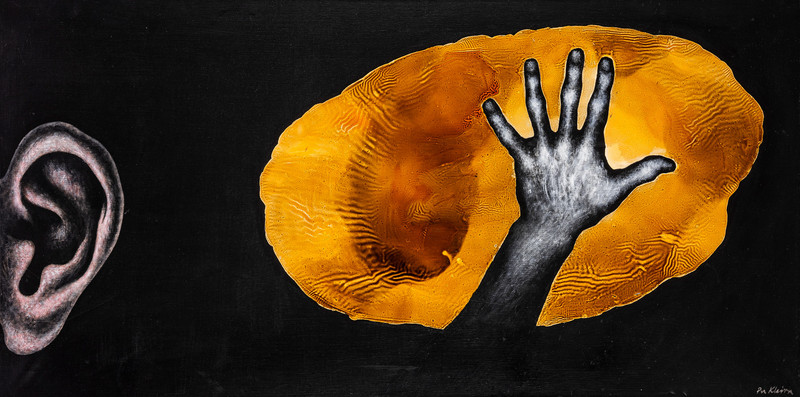
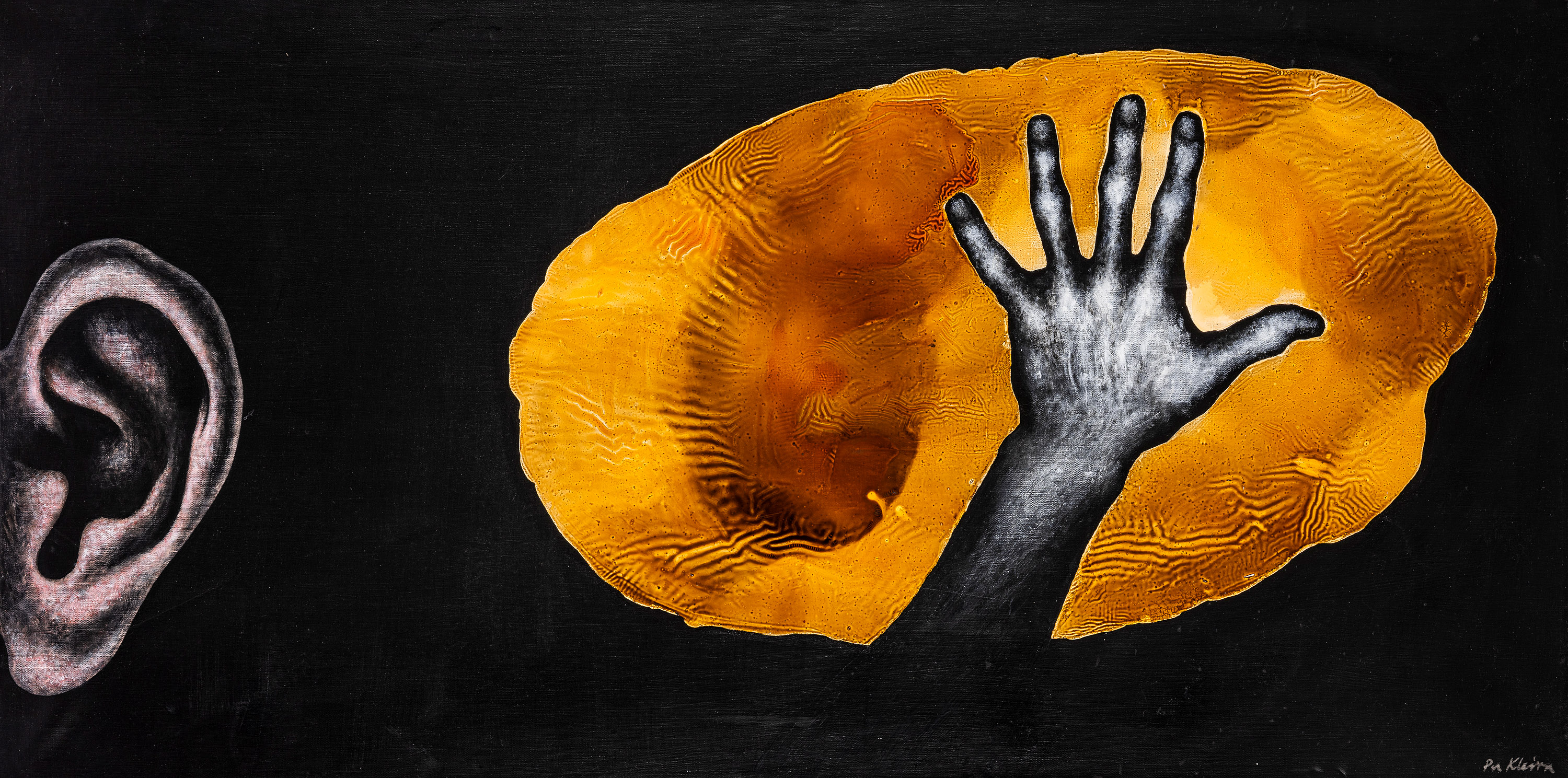
Conch Shell
Throughout his career, Per Kleiva (1933–2017) explored the relationship between politics, nature and human experience. Whether working in printmaking, sculpture or assemblage, he created images that brought together beauty and unease, hope and critique.
When Kleiva made his debut in 1964, he spoke of improvised jazz as an important source of inspiration for his work. Its spontaneous energy and unexpected rhythms also informed his artistic practice, which frequently challenged established conventions and sought new forms of expression. American Pop Art provided another significant influence. In early works such as Softly as in a Morning Sunrise (1965), named after a well-known jazz standard, he combined industrial materials, bold contrasts and unexpected forms to create a visual language that was at once playful and disconcerting.
Kleiva continually experimented with materials and techniques, incorporating everything from Plexiglas and wood to discarded industrial objects. It was, however, through screenprinting that he developed his most distinctive artistic expression. The medium enabled him to make his art accessible to a wider audience. During the 1970s, his social and political engagement became increasingly pronounced. Photographs drawn from newspapers and other media were combined with vivid colours and graphic forms, transforming current events into striking and powerful visual statements.
Kleiva never confined himself to a single style or genre. Throughout his career, he combined political incisiveness with poetic sensitivity and visual inventiveness.
As a member of the left-wing artist collective GRAS, Kleiva created his best-known work, American Butterflies (1971). With its striking juxtaposition of beautiful butterflies and military helicopters, the work has become an iconic image of Norwegian opposition to the Vietnam War. It exemplifies Kleiva's tendency to bring seemingly opposing elements into confrontation: beauty and violence, nature and technology, life and destruction.
His commitment to the cause of oppressed groups was also expressed in several significant works from the 1980s. During the Alta conflict, Kleiva created Sámi Dwelling (1980), a powerful statement of solidarity with the Sámi people's struggle for rights and self-determination. The work formed part of a series of monumental sculptures exploring symbols of power and control.
Kleiva never confined himself to a single style or genre. Throughout his artistic career, he combined political incisiveness with poetic sensitivity and visual inventiveness. His imagery is characterised by encounters between seemingly opposing forces, creating a field of visual tension: nature and technology, hope and despair, beauty and conflict.