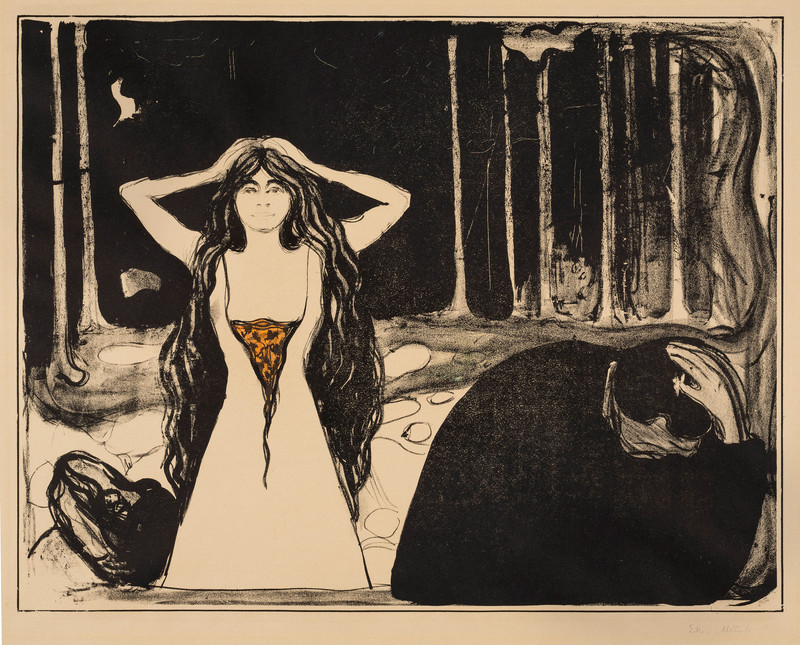
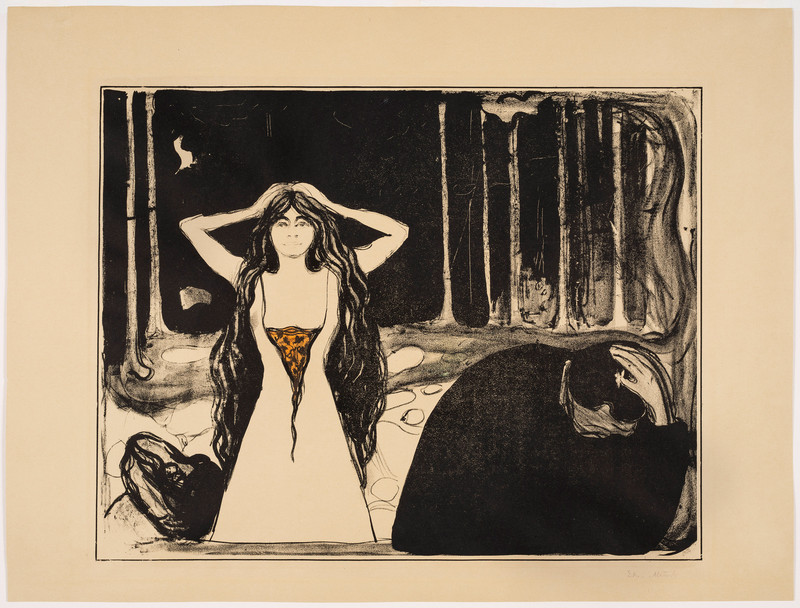
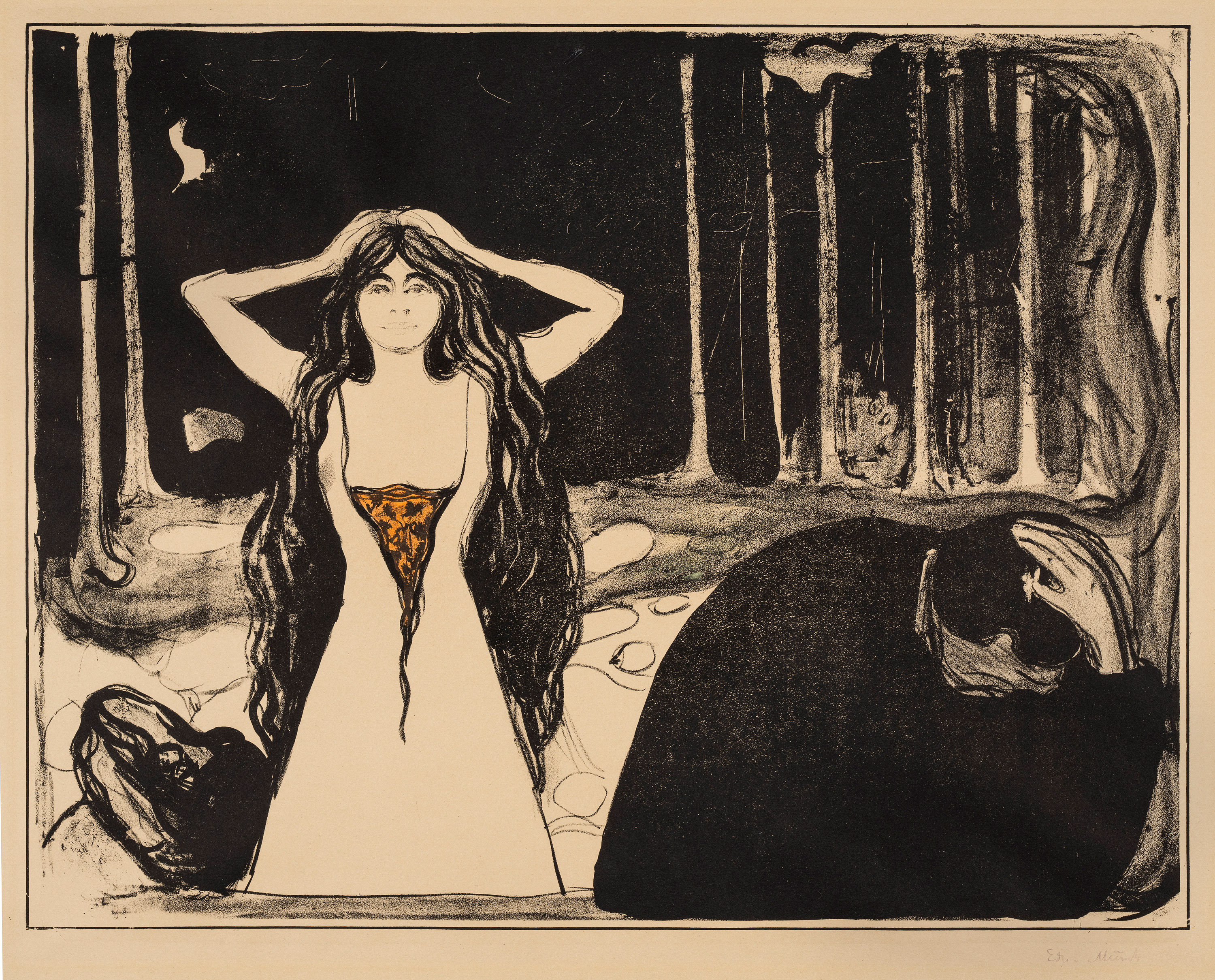
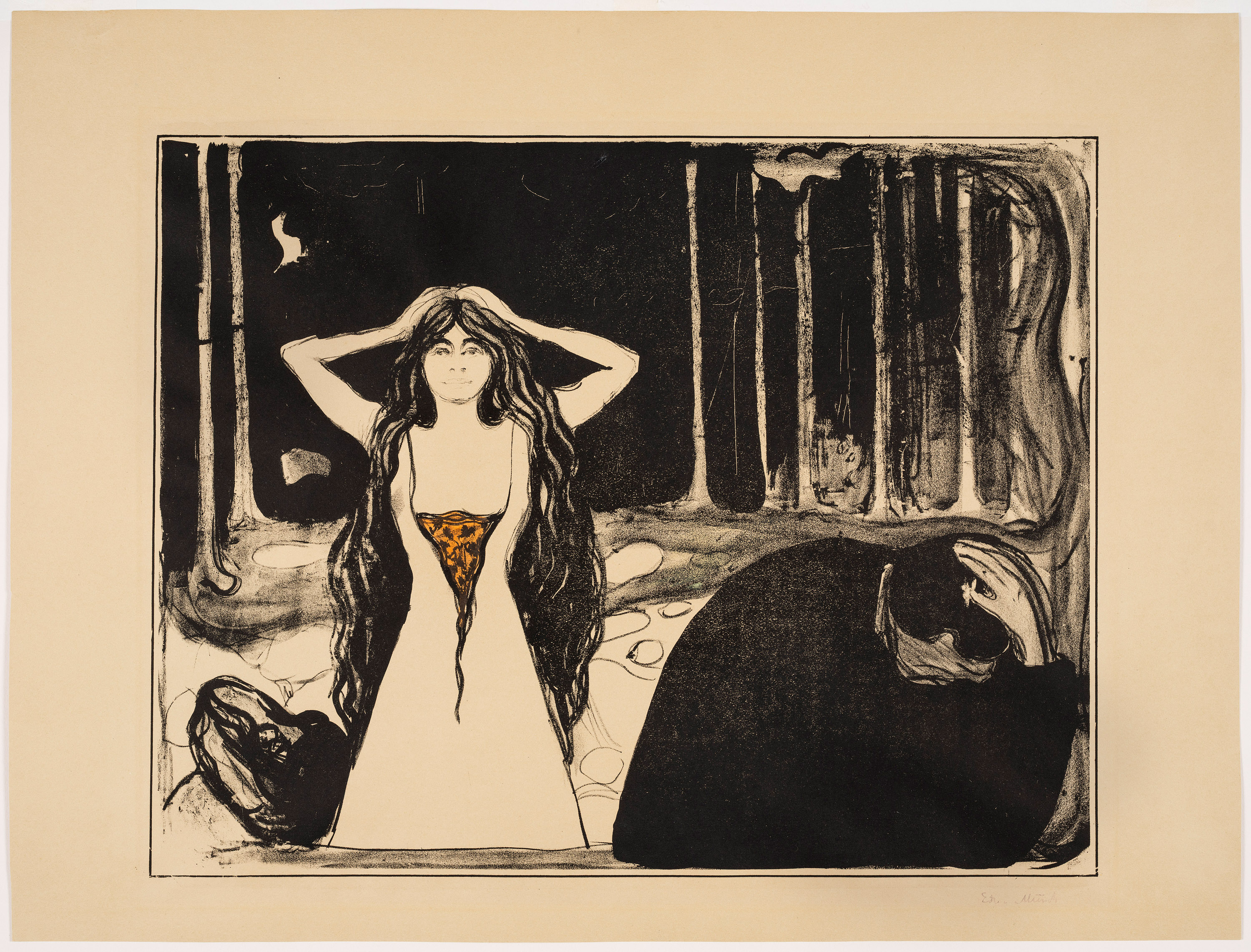
Ashes II (1899)
Edvard Munch clearly drew inspiration from Impressionism and Neo-Impressionism during his stay in Paris from 1889 to 1891. However, the influence that proved most decisive for his artistic development over time came from Symbolism, particularly the work of Puvis de Chavannes. It was during this period that Munch formulated his St. Cloud manifesto, declaring his departure from traditional genre painting: “No longer should interiors be painted, people reading and women knitting. There should be living people who breathe and feel, suffer and love.”
At this stage, Munch was already developing the idea of the Frieze of Life, a continuous visual narrative about human existence and the fundamental forces and phenomena of life. This concept was further consolidated and expanded during his stay in Germany from 1892 to 1895. When he exhibited in Berlin in 1892, it was by invitation from the Verein Berliner Künstler. While in Berlin, he became part of the circle around the radical journal Pan and formed connections with figures such as August Strindberg and the Polish writer Stanisław Przybyszewski. Although Munch was influenced by German painters like Böcklin, Klinger, and Thoma, the environment surrounding him was primarily literary, shaped by an interest in Nietzsche, Symbolism, erotic themes, and fantasies of death.
Under these influences, the content of the Frieze of Life began to take clearer form as a series of thematic groups. These included landscapes and figurative compositions inspired by the natural surroundings of the Oslo Fjord. The works conveyed a fusion of nature mysticism and eroticism, merged into an inseparable whole. Examples include motifs such as Mystery of the Shore, The Storm and Madonna. Other works depicted various stages and conditions of human life, as seen in paintings such as Ashes. The deeply pessimistic outlook of the Frieze of Life was expressed through a highly concentrated, expressionistic visual language, related in part to French Synthetism.
Between 1893 and 1894, Munch also began working with graphic techniques such as etching and lithography. In Paris in 1896, he further explored woodcut and color woodcut. Through printmaking, Munch was able to produce and vary the motifs he had developed, including those of the Frieze of Life. As a printmaker, Munch was highly innovative. His etchings, woodcuts, and lithographs are considered artistically equal to his paintings, demonstrating both technical mastery and bold formal experimentation.
Printmaking made it possible for Munch to maintain an active exhibition schedule, helping him stay connected with audiences and critics while also securing an income. At the same time, it allowed him to preserve his life motifs within a coherent framework, even as he continued to rework and transform them into paintings.